
Advertising vs Marketing: What’s the Difference?
Marketing and advertising are often confused as interchangeable terms, but they are distinct concepts that play different roles in business strategy. Understanding the difference between marketing and advertising is crucial for any business aiming for long-term success.
In this blog, we’ll explore the key differences, their role in business, and how they work together to achieve business goals.
What Is Marketing?
Marketing is a broad business practice that involves researching, understanding, and meeting customer needs. It’s an ongoing process that starts with identifying potential markets, defining a target audience, and creating strategies to communicate value to that audience. Marketing includes product development, pricing strategies, distribution channels, branding, customer engagement, and more.
In short, marketing is the roadmap for how a business interacts with its customers. Successful marketing requires a deep understanding of the customers, their needs, and how a company can meet those needs better than the competition.
Key components of marketing include:
- Market Research: Understanding customer preferences, needs, and behaviors through surveys, focus groups, and data analysis.
- Product Development: Creating products or services that align with market demand.
- Branding: Establishing a brand identity that resonates with the target audience.
- Sales Strategy: Determining the best ways to reach potential customers and convince them to purchase.
- Customer Relationship Management: Building long-term relationships for repeat business and customer loyalty.
Marketing focuses on a comprehensive strategy to deliver a product or service that meets customer needs and business objectives.
Types of Marketing
There are different types of marketing; each serves specific goals and audiences.
- Digital Marketing involves using online platforms like websites, social media, and email to promote products and services. Digital marketing is one of the fastest-growing types of marketing because it instantly reaches a global audience.
- Content Marketing: Content marketing focuses on creating and distributing valuable content (like blogs, videos, and social media posts) to attract and retain a clearly defined audience. The goal is to engage and educate potential customers, turning them into loyal buyers.
- Influencer Marketing: This type of marketing leverages the popularity and reach of social media influencers to promote products. Brands partner with influencers with large followings in niche markets to amplify their reach.
- Relationship Marketing: This is focused on building long-term relationships with customers to foster loyalty and customer retention rather than focusing on short-term wins.
- Social Media Marketing: It uses platforms like Facebook, Instagram, and LinkedIn to reach audiences, build brand awareness, and engage with customers.
What Is Advertising?
Advertising, on the other hand, is a specific part of marketing. It involves promoting a product, service, or brand through paid channels. Advertising focuses on grabbing attention and encouraging people to take a specific action, such as purchasing a product or signing up for a service. Unlike marketing, which is a broad strategy, advertising is more targeted and short-term, aiming to drive immediate results.
Advertising can be done through various media, including:
- Television: TV ads remain one of the most impactful advertising methods, particularly for large brands looking to reach a broad audience.
- Radio: Despite the growth of digital platforms, radio advertising still has its place, especially for local businesses.
- Print: Newspapers, magazines, and billboards are print advertising that can effectively reach specific demographic groups.
- Digital Ads: Digital advertising includes banner ads, search engine ads (Google AdWords), social media ads, and more. This form of advertising allows businesses to target specific audiences based on behaviors, interests, and demographics.
- Mobile Advertising: With the rise of smartphones, mobile advertising has become crucial for reaching on-the-go consumers. This includes in-app ads and push notifications.
Advertising is about communicating a clear and persuasive message to convince people to take action quickly.
Difference Between Marketing and Advertising
Now that we’ve defined marketing and advertising, let’s break down the key differences between the two:
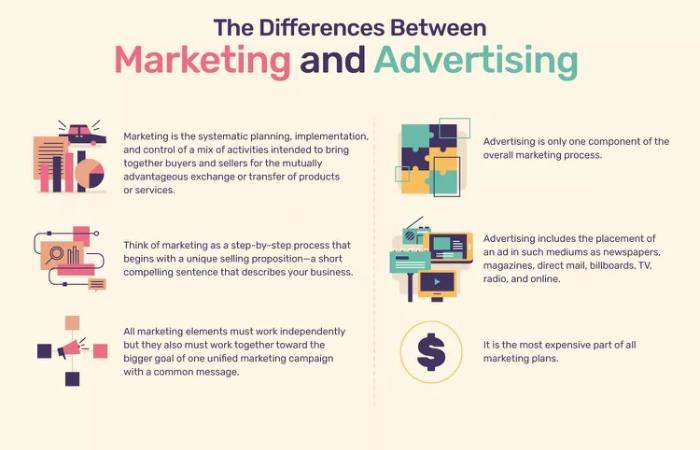
- Scope: Marketing is a comprehensive business function that includes research, product development, branding, and more. Advertising is just one component of marketing focused on promoting a product or service.
- Approach: Marketing is a long-term, ongoing process that builds customer relationships and understands their needs. Advertising is typically a short-term, focused effort to drive immediate sales or brand awareness.
- Goal: Marketing aims to build a customer base by understanding their needs and offering solutions. Advertising’sAdvertising’s goal is to promote those solutions to a broader audience, encouraging them to take action.
- Cost: Marketing efforts, especially digital marketing, can often be done with a limited budget or even for free through social media and SEO. Advertising usually requires a financial investment, as businesses must pay for ad space in various mediums.
- Control: Marketing involves controlled (paid media) and uncontrolled (earned media, word-of-mouth) channels. In advertising, businesses have complete control over the message but must pay to distribute it.
- Measurement: Marketing success is measured by long-term metrics such as brand loyalty, customer satisfaction, and lifetime customer value. Short-term metrics like conversions, clicks, or impressions measure advertising success.
How do Marketing and Advertising Work Together?
While marketing and advertising serve different purposes, they are closely related and work best when used together. Effective marketing strategies often include advertising to amplify reach and drive sales. Here’s how the two collaborate:
- Brand Awareness: Marketing builds brand awareness by creating a brand identity and engaging with customers. Advertising boosts this awareness by putting the brand in front of more people.
- Lead Generation: Marketing generates leads through content, social media, and SEO. Advertising converts those leads into customers by driving them toward a specific offer or action.
- Customer Engagement: Marketing keeps customers engaged with informative content and consistent messaging. Advertising prompts action, such as making a purchase or signing up for a newsletter.
For example, a company may run a content marketing campaign that focuses on educating its audience about the benefits of a new product. The marketing team may create blog posts, videos, and infographics to generate interest. The advertising team then follows up by running paid ads on social media and search engines to promote the product directly to potential customers.
The Role of SEO in Marketing and Advertising
Search engine optimization (SEO) is critical in marketing and advertising. SEO ensures that your content ranks highly on search engines for marketing, driving organic traffic to your website. This is essential for long-term growth and brand visibility.
In advertising, SEO can inform pay-per-click (PPC) campaigns by helping businesses target the right keywords and optimize ad copy. Understanding what keywords people search for allows businesses to tailor their ads to match user intent, resulting in more effective ad placements.
Marketing vs. Advertising – Which Is Better?
Marketing and advertising are both critical for the success of any business! They work together to make a significant impact. Marketing helps us understand our customers and deliver products that meet their needs, while advertising spreads that message and brings immediate results.
Let’s Wrap it Up.
For businesses, the key is to develop a solid marketing strategy first and then invest in advertising to promote that strategy. Whether running a small local business or a global enterprise, the right balance of marketing and advertising can help you reach your business goals. Understanding the difference between marketing and advertising allows companies to make informed resource allocation decisions for maximum impact.